

Cover Letter Guide
How to Write a Cover Letter From Your Resume
Cover letter from resume writing is one of the easiest ways to create a stronger job application without starting from a blank page. Your resume already contains your experience, skills, achievements, and direction. The next step is turning that information into a more personal, targeted explanation of why you fit the role.
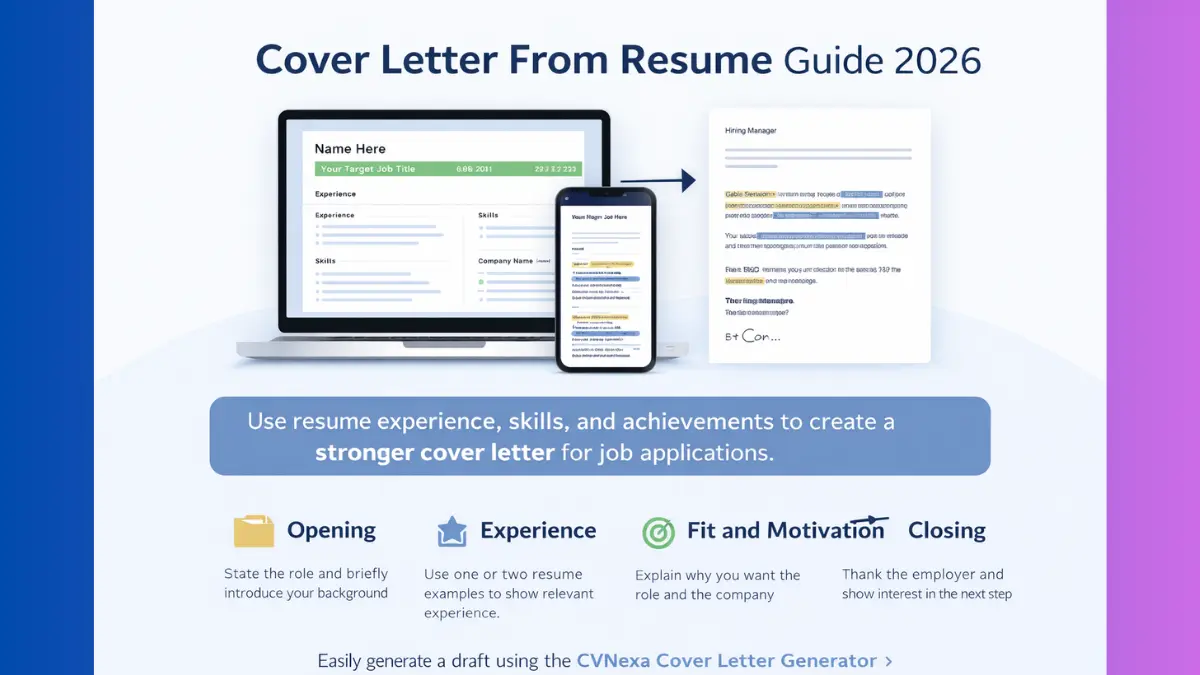
If you want a faster way to build a first draft, try the CVNexa Cover Letter Generator. It helps you turn resume content into a more structured and editable letter.
- Why a cover letter from resume works
- What to take from your resume
- How to write a cover letter from resume details
- How to turn resume bullets into cover letter sentences
- Common cover letter mistakes
- Use a cover letter generator
- Best workflow for job applications
- Helpful resources
- Frequently asked questions
Why a cover letter from resume content works better
Many job seekers struggle because they try to write a cover letter before organizing their thoughts. A better approach is to begin with your resume. Your resume already shows your work history, achievements, education, and key skills. A cover letter should build on that foundation rather than compete with it.
When your resume and cover letter support each other, your application feels more consistent. Employers can quickly understand your background, your value, and your fit for the role. That makes the entire application more persuasive and easier to review.
What to take from your resume before you write
Before drafting your letter, pull out the parts of your resume that matter most for the job you want. This helps you stay focused and avoid writing generic paragraphs.
- Your target job title
- Your most relevant recent work experience
- The skills that match the position
- One or two measurable achievements
- A clear reason why you fit the opportunity
Once you collect these points, writing a cover letter becomes much easier because you already know what to emphasize.
How to write a cover letter from resume information
The easiest way to write a strong letter is to move step by step instead of trying to perfect everything at once. When you use resume details carefully, your letter becomes more relevant, more convincing, and easier for employers to follow.
1. Start with a clear opening
Mention the role you are applying for and briefly introduce your background. Keep the opening direct and relevant. A strong introduction tells the employer why you are writing and why your background deserves attention.
2. Turn resume achievements into proof
Use one or two examples from your resume to show value. This is where your experience becomes more persuasive. Instead of listing everything you have done, focus on the responsibilities and achievements that relate most closely to the job description.
3. Explain your fit and motivation
A good job application cover letter explains more than experience. It should also show why you are interested in the role or company. Mention relevant strengths, working style, or career direction that make you a suitable match.
4. Close professionally
End with a short, confident closing. Thank the employer for their time and express interest in the next step. A professional close makes the letter feel complete without becoming too long.
How to turn resume bullets into cover letter sentences
Resume bullet points are short and factual. Cover letter sentences should connect those facts into a smoother explanation.
For example, a resume bullet may say:
“Managed digital campaigns and increased organic traffic by 34%.”
In a cover letter, that can become:
“In my recent marketing role, I managed digital campaigns across multiple channels and helped increase organic traffic by 34% through SEO improvements and stronger content planning.”
The information stays aligned with the resume, but the wording gives it more context and relevance.
Use the CVNexa Cover Letter Generator to turn resume experience into a structured, editable cover letter draft faster.
Common mistakes when creating a cover letter from resume content
Repeating the resume line by line
Your letter should support the resume, not duplicate it. Choose the strongest details and explain why they matter.
Using weak generic claims
Phrases like “I am hardworking” or “I am passionate” are not very convincing unless you support them with real examples or outcomes.
Making the letter too long
A strong letter is usually concise. Focus on relevance, clarity, and value rather than trying to summarize your entire career story.
Ignoring the target role
A resume to cover letter approach only works well when the final letter is matched to the specific job. Always connect your background to the actual role you want.
Use a cover letter generator after your resume is ready
Once your resume is complete, the fastest next step is to use a cover letter generator that turns your resume background into a structured first draft.
The CVNexa tool helps you move from resume to cover letter more efficiently by organizing your experience, skills, and job fit into an editable format you can personalize for each application.
If you still need to improve your resume first, use the Resume Builder and review it with the ATS Resume Checker before generating your letter.
Best workflow for a stronger job application cover letter
A simple workflow makes the process easier:
Build Resume → Check ATS → Generate Cover Letter
Start with the Resume Builder, review your resume in the ATS Resume Checker, then create a draft using the Cover Letter Generator.
Helpful resources for better cover letter writing
It also helps to review broader job application guidance from CareerOneStop and career writing information from Purdue OWL. These resources can help you understand how professional application documents are structured.
Frequently asked questions about writing a cover letter from resume content
Can I create a cover letter from my resume?
Yes. Your resume already gives you the main information you need. The cover letter simply explains why that experience matters for the role.
Should the cover letter match the resume?
Yes. Your job title, experience level, skills, and achievements should stay consistent across both documents.
Do I still need to edit a generated cover letter?
Yes. A generator creates a strong starting point, but the final version should still be personalized for the company and role.